
Investing
This is about my journey as an investor in the stock market. It’s probable that someone else has said all of this before, but better.
Four years ago, I put most of these thoughts on paper. I never published the article, though. I accidentally found it again just now, while building a platform where I intend to write and publish articles. So I thought: why not give it some final touches and publish it for the world to see?
When I originally wrote this, it had been four years since my first investment. Now it’s closer to ten, but surprisingly, the article didn’t feel very outdated when I read it. So, starting from the next paragraph and until I tell you otherwise, every point in time I reference (unless it’s a specific date) is approximately six years in the past. At the end, I’ll return to the present and add some final thoughts THAT WILL BLOW YOUR MIND (clickbait).
I’ll focus on my experience, together with a few reflections. This isn’t going to teach you how to pick specific stocks. And you don’t want to learn that from me anyway. My strategy is difficult to replicate, and I have a bad track record.
The reason I started investing, and why I’m writing this, is that I work as a developer at a fintech company in Stockholm. Naturally, talking to people who are passionate about investing was inspiring. The original inspiration for this article mostly came from hiring new developers who were in the same position I was six years ago. They started asking questions, and my answers weren’t as cohesive as I wanted them to be. So I put my thoughts in writing to give myself some clarity.
The first shares I bought were a few shares of Paradox Interactive on 2017-02-28. Even though I had no idea how to value the company, this is surprisingly close to what I would recommend doing if I could start over.
The first reason is that I invested a very small amount of money. My personal finances wouldn’t change if it went 10x or to zero. When you have no idea how to value a company, I think that’s important. You should have the intention to learn while, of course, trying your best to make good investments. Then, as your knowledge and confidence grow, you can scale up your investments.
The second reason is that I was, and still am, one of their customers. That made me consume a lot more information because I found it more interesting to read about the company.
Buying a company that sells products I actually use was, in hindsight, also one of the best tools I had for valuing a company back then. It also makes it less likely to be an outright scam or money grab.
Research takes time
Doing proper research takes time. As of writing this, I spend approximately two hours per week, plus whatever I naturally get through my work. That will never be enough for me to consistently get good returns without a lot of luck.
But I’m slowly building a long-term portfolio, and for the first time ever I hold two positions where my conviction that they’ll outperform is very high. Two of my other positions are essentially adoptions from better investors, where I still don’t fully understand all the details of the case.
If you’re lucky enough to be in an environment with knowledgeable investors, I think this is something you can do. Try to understand their case and learn from it. But remember that, in the end, you are solely responsible for your portfolio.
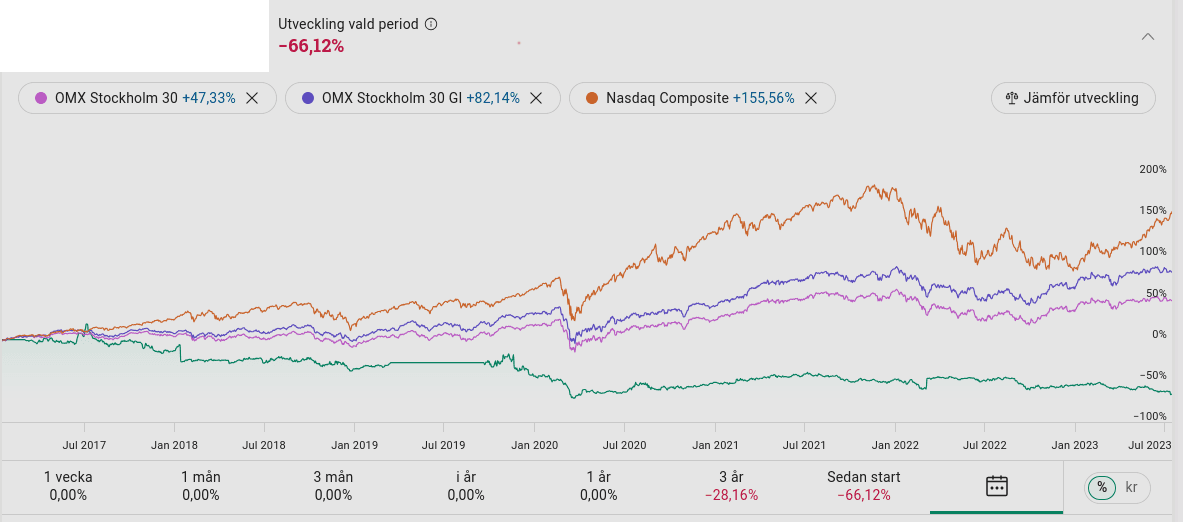
Early on, I managed to lose a large portion of what I invested, as shown in the graph above. The reason I’m showing it is that there’s a big bias in the graphs people tend to share. Those graphs tend to go up.
Investing isn’t my job. It’s just one of my many hobbies. I think you should expect to spend far more time than I do if you want investing to ever become a meaningful part of your income. I’ve seen the passion and amount of time some of the best investors in Sweden spend on the market, and I know that will never be me.
As you can see, I probably lost money, but the graph looks much worse than the result in SEK because of how much I invested at different times.
Note from the future, 2021, when this was originally written: Even though the portfolio looks 66% down, it was slightly positive in absolute numbers. Before this portfolio was completely emptied, it was slightly down in absolute numbers.
Timing matters
Another thing I experienced was the untimely liquidation of all my holdings when I decided to buy my first home. This made me sell my largest holding at what is still its all-time low today.
What I’d like to say with this is that timing matters. Even if you’re right, you can still lose with the wrong timing.
If I were in the same situation today, I would simply keep cash until I had bought my first home and built up a large buffer for unexpected events.
“Is it too late to invest in stock X?”
This is such a common question from new investors. And this is always asked after the price of X has surged.
And the answer is: I don’t know.
What I can say is that the fact that the price has surged doesn’t tell you much about whether it’s worth investing today if you have something resembling a long-term fundamental strategy. In most scenarios, you probably should have been even more interested in the company before the surge.
This is because it’s very rare for fundamentals to be more volatile than the share price.
To circle back to my own experience: one of my two best-performing positions was bought close to an all-time low, while the other had just surged 3x over a few months. The price history wasn’t the reason I bought either of them.
It's ALIVE, and MOVING.
I have one more question I want to explore before closing this article:
"why is stock X up or down on a given day?"
There’s one primary scenario when I get asked this: when there’s what looks like good news, but the stock trades down.
The answer is, once again: I don’t know.
In small and nano-cap stocks, which sometimes have been the shares in question, it could be as simple as some investors deciding to buy or sell. Good news could trigger a surge in liquidity, giving a large owner who has been trying to exit an opportunity to sell.
But I actually think the most common explanation when a new investor asks this is that expectations were so high that what you consider good news is considered bad news by the market.
Six years later
Now we’re back in 2026.
I think I still mostly stand by what I wrote above. But I’ll add some context on what has happened since, as well as one slight correction.
I’ll start with the correction: I no longer think any of my liquidations was particularly untimely. And definitely not particularly unlucky. The point I made still stands, though.
Yes, if I had waited three more months, I would have tripled my portfolio without liquidating. But I now think that would have been extremely lucky timing, rather than evidence that I made a particularly bad decision.
Timing is difficult, and I’ve had my fair share of both good and bad timing.
I also want to expand on the point I made earlier:
“If I were in the same situation today, I would simply keep cash until I had bought my first home and built up a large buffer for unexpected events.”
I spoke about this recently, and I think it comes down to understanding risk.
And I think risk is a very misunderstood concept.
It’s finally time for the “blow your mind” clickbait I promised!
What is risk?
Most of the time when people talk about financial risk, they’re talking about the risk of one asset relative to the currency where they live.
And that makes sense. Eventually, that person probably wants to liquidate the asset into currency to buy something.
But did you know there’s also risk between the currency and what you actually want to buy?
So holding what you eventually want to buy could be considered less risky.
And this next thing will blow your mind even further (it really shouldn’t).
In many cases, there are other assets whose prices correlate better with what you eventually want to buy than your currency does.
An example that many people intuitively understand is property. If you eventually want to buy a property in a particular area, owning property in that same market can, in some respects, be less risky than holding currency when you evaluate the risk against property prices in that area.
Let’s pretend your mind was blown and you started thinking. But now you’re probably asking: is this actually applicable to any real-world scenario?
This is something I’m still figuring out myself. But it really is how I tend to frame risk in real-life situations.
My favorite example is making decisions about my pension. It’s a favorite because it’s a case where I and many others want to minimize risk rather than maximize potential returns.
Because my pension is so far in the future, I think trying to minimize risk against the SEK (currency of Sweden) is a bad idea.
The correlation between SEK and the things I’ll want to buy many, many years from now is probably alright. I’d be surprised if it wasn’t one of the least volatile alternatives.
But volatility matters little when you have a very long investment horizon. The opposite is also true: volatility matters a lot over a short horizon.
I think there are instruments that, over the long term, actually correlate better with what I’ll want to buy when I’m old.
And when you frame it like that, you can see how holding SEK for my pension could actually be considered a risky option.
What I’m actually doing now
The biggest change since writing the original article is that I’m no longer looking to actively spend time on investing as a hobby.
Instead, I’m writing this website, playing Magic, designing games, exercising more, spending time with family and friends, and doing everything else life has to offer.
So most of my investments are now cheap passive funds.
But sometimes something interesting still randomly drops into my lap, and I get the itch to read up on it and potentially invest.
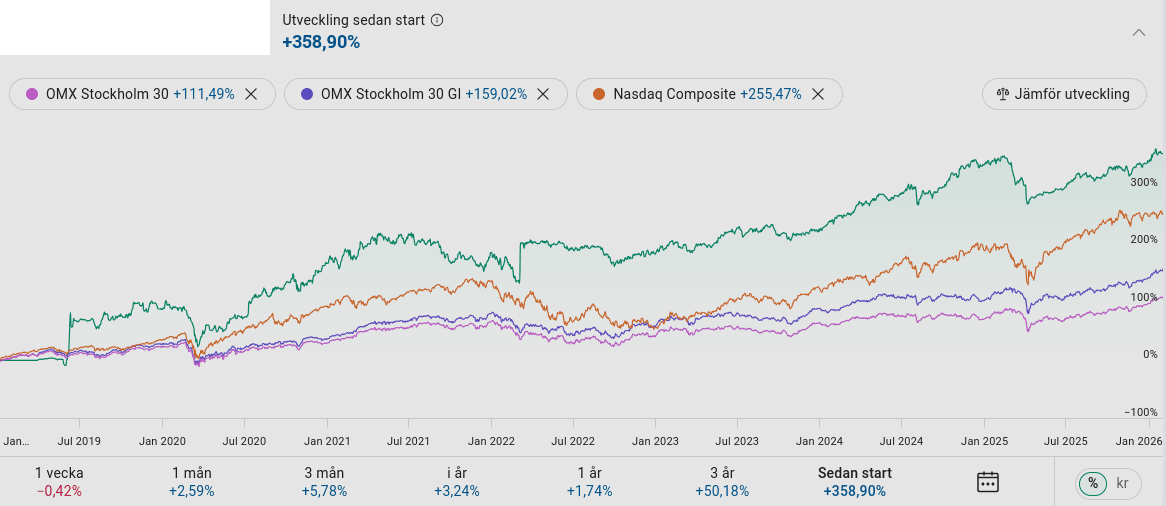
Just after writing the original article, my performance peaked. Since then, I’ve made back a magnitude more than I had lost at the time. Over the last few years, my performance has increasingly started to mimic different indices as I’ve decreased my activity.
The graph below isn’t from the same portfolio as the graph above. But it’s the only one that has been active since then.
I also learned that my writing is more relaxed now than six years ago. I changed some parts to make it feel slightly more alive 🤷 Sadly I'm not a much better writer 😭
Also, don’t feel bad if there was something you didn’t understand. I think the financial sector as a whole still hasn’t figured out how corporate actions work 😭
They also love generating random numbers to make uninformed decisions and then telling you how smart they were after the fact, thanks to a healthy dose of survivorship bias.